The Legend of Smokey Yunick’s 7/8 Scale Chevelle
Title: Smokey Yunick’s 1966 Chevelle: The “7/8 Scale” Myth & The 5-Gallon Fuel Line
Category: Outlaw Tech / NASCAR Folklore
The Hook:
Most mechanics read the rulebook to find out what they are allowed to do. Henry “Smokey” Yunick read the rulebook to find out what NASCAR forgot to forbid.
In the late 1960s, NASCAR was a fistfight between Detroit factory money and backwoods garage geniuses. Operating out of his legendary “Best Damn Garage in Town” in Daytona Beach, Florida, Smokey didn’t have GM’s corporate budget. What he had was a slide rule, an aviation background, a pipe clamped between his teeth, and total contempt for tech inspectors.
His masterpiece was a sleek, black-and-gold #13 1966 Chevrolet Chevelle. When it rolled into Daytona, it didn’t just bend the rules—it shattered the timeline of race car engineering.
The “7/8 Scale” Urban Legend:
When the Chevelle rolled into the inspection bay, it looked alien next to the other cars. It sat lower, punched through the air cleaner, and was brutally fast. Competitors looked at it, looked at their own boxy factory Chevelles, and started crying foul. The rumor blew up immediately: Smokey fabricated a 7/8 scale miniature Chevelle body from scratch.
The truth was even slicker:
The Body Drop: Smokey didn’t shrink the car; he sectioned and tucked everything. He took an inch out of the roofline, shaved the drip rails flush, and smoothed the entire belly pan with aerodynamic belly tins decades before ground effects were a thing.
The Frame Trick: The rulebook explicitly stated that you couldn’t move the engine back in the chassis. Smokey smiled, left the engine mounts untouched, and moved the entire sheet-metal body forward on the frame by three inches. Technically, the engine never moved. The front-to-rear weight balance was perfected.
The Bumper Air Dam: He narrowed the rear bumper to tuck into the slipstream and sectioned the front bumper into a razor-sharp front air dam.
The 5-Gallon Fuel Line:
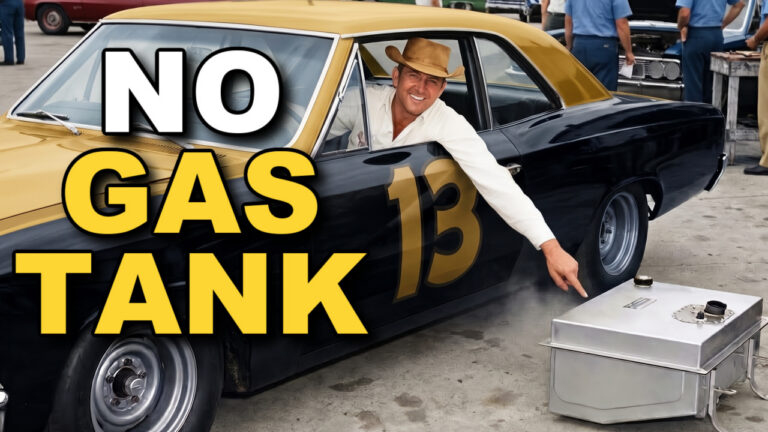
NASCAR tech officials tore the Chevelle apart looking for cheats. They handed Smokey a punch list of nine separate infractions. Fed up, the inspectors pulled his fuel cell clean out of the trunk to measure its volume in a wash tub. It held the legal 22 gallons. Exactly as written.
As the story goes, the lead inspector handed Smokey the clipboard and said, “Your gas tank is out on the floor. You can’t race this car.”
Smokey reached in, fired the starter, revved the big-block 427, and said:
“Well, make that ten things.”
He dropped it into gear and drove the car straight back to his garage without a fuel tank in the car. He had fabricated an eleven-foot-long, two-inch-thick steel fuel line snaking inside the frame rails and chassis tubes. It held five gallons of high-octane gasoline between the tank and the carburetor.
Smokey didn’t cheat the rules—he simply operated where the rules hadn’t been written yet.
SHOP THE ETSY STORE

Tess Drive YouTube Channel

“Follow us on Pinterest for vintage rides, garage vibes, and Relic heritage designs.”
