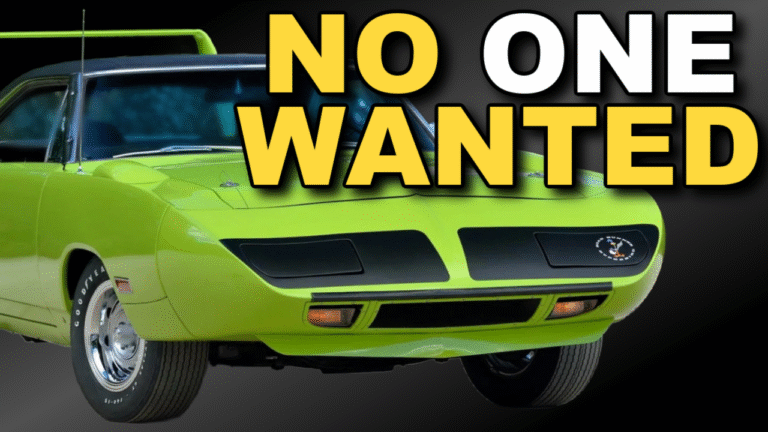
You ever walk into a place expecting one thing and find a monster sitting where the family car should be? Spring, 1970. Plymouth showroom. Fluorescent lights. Brick wall. Big banner that says Rapid Transit System.
You’re thinking slant-six Duster. Something that fits in the garage and doesn’t scare the insurance man. Then you see it. Nineteen feet of lime-green missile. Nose like a beak. Wing on the back tall enough to scrape the tiles if you aren’t careful.
That’s the Superbird. And the only reason it’s on showroom tile instead of a banked oval is because one man called Chrysler’s bluff and walked. Late ’68. Richard Petty. The King. He goes into the Plymouth offices and tells them straight. Dodge just showed the winged Charger Daytona.
Build me an aero car that can beat the Ford Torinos on the high banks, or I’m gone. Plymouth looks at their biggest star and says no. We’re the family brand. Dodge can have the crazy stuff. You stick with the regular Road Runner. Petty doesn’t yell. He doesn’t slam the door. He walks across the street to Ford. Paints a Torino Talladega Petty blue. Wins ten races in 1969. Chrysler watches the points and realizes the quiet part out loud.
Richard Petty is Plymouth. So they call the engineers and say build it. Bring him home. Now NASCAR changes the rules on them. Used to be you only had to build five hundred street cars to make the race version legal. For 1970 Big Bill France says one street car for every two dealers in the country. That means Plymouth has to build nineteen hundred and twenty of these things. For regular people.
Not just the track. The engineers don’t just copy the Daytona. They use Coronet front fenders. New steel nose, nineteen degrees, with vacuum pop-up headlights so a guy can actually drive it home after dark without looking like he’s aiming a rocket at the neighbor’s mailbox. And that wing. For thirty years the company line was it stood twenty-four inches high so you could open the trunk and get your groceries.
That was the story they told the bean counters and the insurance desks. Truth was in the wind tunnel. Dirty air rolling off that fastback window was killing the rear grip. To stay planted at two hundred miles an hour the wing had to sit up in clean air. Trunk opening underneath was just luck. Petty sees it.
Smiles. Signs. Comes back. The car is so good on the big tracks that after 1970 NASCAR basically outlaws the big-block winged cars. Too dominant. But the showroom is a different country. People don’t know what to do with a cartoon car. Won’t fit a normal garage. Pointed nose gets bent the first time you try to park at the grocery store. High-compression engine and that wing make the insurance quote sound like a joke that isn’t funny. Dealers can’t move them.
By late 1970, into ’71 and ’72, Superbirds are sitting in the back rows. Sun-faded. Dusty. Priced under three thousand just to get them gone. That’s when some of the service managers do the thing you still hear about in shops. Cut-off wheels. Torches. They unbolt the steel nose. Throw on a regular Road Runner grille and flat hood.
Chop the wing off. Slap a plain trunk lid on. Push it to the front line and sell it as a discounted Road Runner so the floor-plan money comes back. Thousands of dollars of aero steel ends up in the scrap pile behind the bay. The car that was built to win on Sunday gets butchered on Monday so the lights stay on.
Today a real numbers-matching Superbird can bring six figures at auction. The same car salesmen cut apart with air chisels just to make payroll is now one of the icons. The leftovers became the legend because almost nobody wanted them when they were new.
So I’m standing here next to this green one in the showroom light. Nineteen feet. Wing up high. Would you have had the nerve to drive it home in 1970? Or would you have walked past it for the plain Road Runner that fit the garage and didn’t make the insurance man nervous?
SHOP THE ETSY STORE

Tess Drive YouTube Channel

“Follow us on Pinterest for vintage rides, garage vibes, and Relic heritage designs.”
