The 90-Day Declaration of War
In February 1964, Richard Petty and Chrysler rolled into the Daytona 500 with their brand-new, hemispherical-chambered 426 Hemi and obliterated the field, taking the top three spots. Ford’s reigning 427 High-Riser V8 was suddenly outgunned.
Ford executives didn’t call a committee meeting; they gave engine engineer Norman Faustyn and his skunkworks team an impossible mission: build an engine that would crush Chrysler, and do it in 90 days.
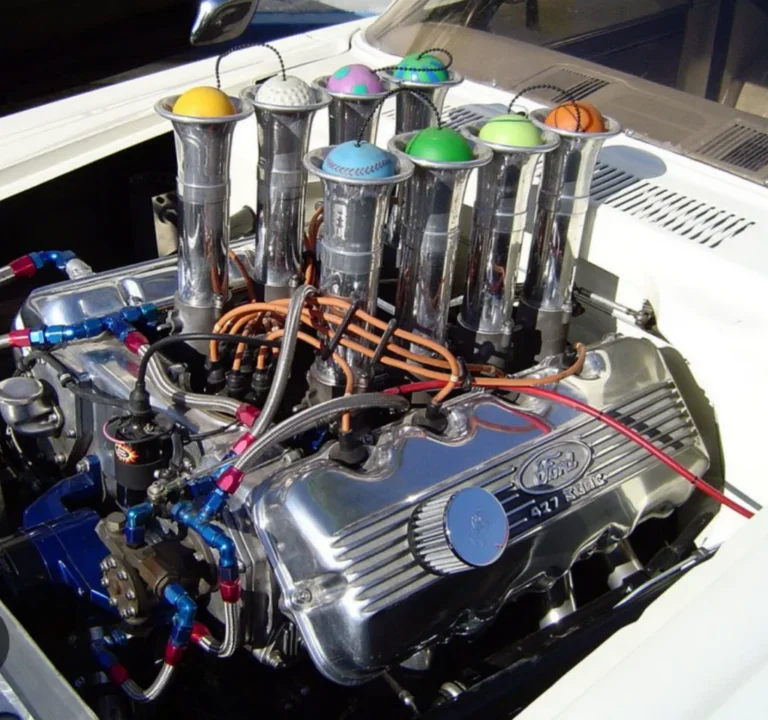
Three months later, Ford dyno-tested the most audacious American V8 ever constructed: the 427 SOHC “Cammer.”
Outlaw Architecture: Ditching the Pushrods
The American muscle car era was defined by the pushrod V8. Ford threw that playbook directly into the scrap bin:
Overhead Camshafts: Instead of running pushrods and lifters down inside the block, Ford engineered cast-iron cylinder heads with a single overhead camshaft sitting directly on top of each bank.
Hemispherical Chambers: The SOHC design allowed for massive hemispherical combustion chambers with massive 2.25-inch intake valves, allowing the engine to flow air like an aircraft motor.
The Infamous 6-Foot Timing Chain: Connecting the crank to both overhead cams required a single timing chain that was nearly six feet long (over 70 inches). When it spun past 7,000 RPM, the chain stretched and whipped so violently that timing would vary by up to several degrees between cylinder banks—a mechanical quirk that engine builders like Ed Pink eventually tamed with precision gear drives.
Raw Numbers: On dual four-barrel carburetors, the 427 SOHC made 657 horsepower at 7,500 RPM and 575 lb-ft of torque. In 1964, that was unprecedented factory output.
The Outlaw Ban: Bill France Shuts the Door
When Ford brought the engine to NASCAR tech inspection for the 1965 season, Chrysler went ballistic. Chrysler threatened a total boycott if NASCAR allowed an exotic overhead-cam engine to race against production-based pushrod engines.
NASCAR boss Bill France agreed. He issued a ruling that banned the 427 Cammer from Grand National stock car competition before it ever turned an official lap, claiming the engine was “not a regular production option available to the general public.“
Ford offered to sell Cammers over the parts counter to anyone who wanted one for roughly $2,300 (nearly the price of an entire base Mustang at the time), but NASCAR wouldn’t budge.
Drag Racing Immortality
NASCAR may have locked the front gates, but Ford took the Cammer around back to the drag strips.
Slapped into lightweight Ford Fairlanes, Mercury Comets, and experimental match-race Funny Cars, the 427 Cammer found its true home. Drag racing legends like “Dyno Don” Nicholson, Connie Kalitta, and Mickey Thompson dropped the blown SOHC into early flip-top Funny Cars, blowing past 200 MPH and destroying the competition on nitro.
The 427 Cammer never got its day on the high banks of Daytona, but it achieved something even better: it became the most legendary forbidden engine Detroit ever built.
SHOP THE ETSY STORE

Tess Drive YouTube Channel

“Follow us on Pinterest for vintage rides, garage vibes, and Relic heritage designs.”
